
Bigger Isn't Always Better
A huge factory looks impressive on paper. But imagine you're developing a new 400 GSM hoodie — an acid wash, a cold dye, a special embroidery, a new fit — and you don't even know yet if your customer will buy it. Do you really need a factory built around 50,000-piece programmes to find out? Probably not. Capacity and capability are not the same thing, and if you're comparing options for a sustainable, wholesale-ready clothing range, that difference matters more than the headline production number.
A supplier can be brilliant at producing 100,000 proven T-shirts and still struggle with 500 complicated hoodies. Another supplier might be excellent at development, washes, small runs and difficult products, but completely wrong for a basic 200,000-piece programme. Same industry, different job.
What "Ethical Clothing Manufacturers UK" Search Results Don't Tell You
Searching for ethical clothing manufacturers UK can help you find potential partners, but a search result isn't proof. Ask where production actually happens, who makes the garments, how working conditions are checked, and what evidence supports the claims. A UK office alone doesn't answer those questions — and a small order alone doesn't make a sustainable programme either. The materials, manufacturing processes and product quality still matter, and should be backed by audit evidence you can ask for directly, not just a badge on a homepage.
Ask What the Supplier Is Actually Good At
This is where I think buyers sometimes make sourcing more difficult than it needs to be. They ask: who can give me the best price? Who has the biggest capacity? Who can make everything? Maybe the better question is: what exactly do I need this supplier to be good at? When you're comparing results for ethical clothing manufacturers UK, look beyond the headline. Can they develop your product? Can they explain their supply chain? Can they deliver consistent quality at your starting quantity? Those are the conversations worth having before a single sample is cut.
Your First 500 Pieces Are Doing Two Jobs
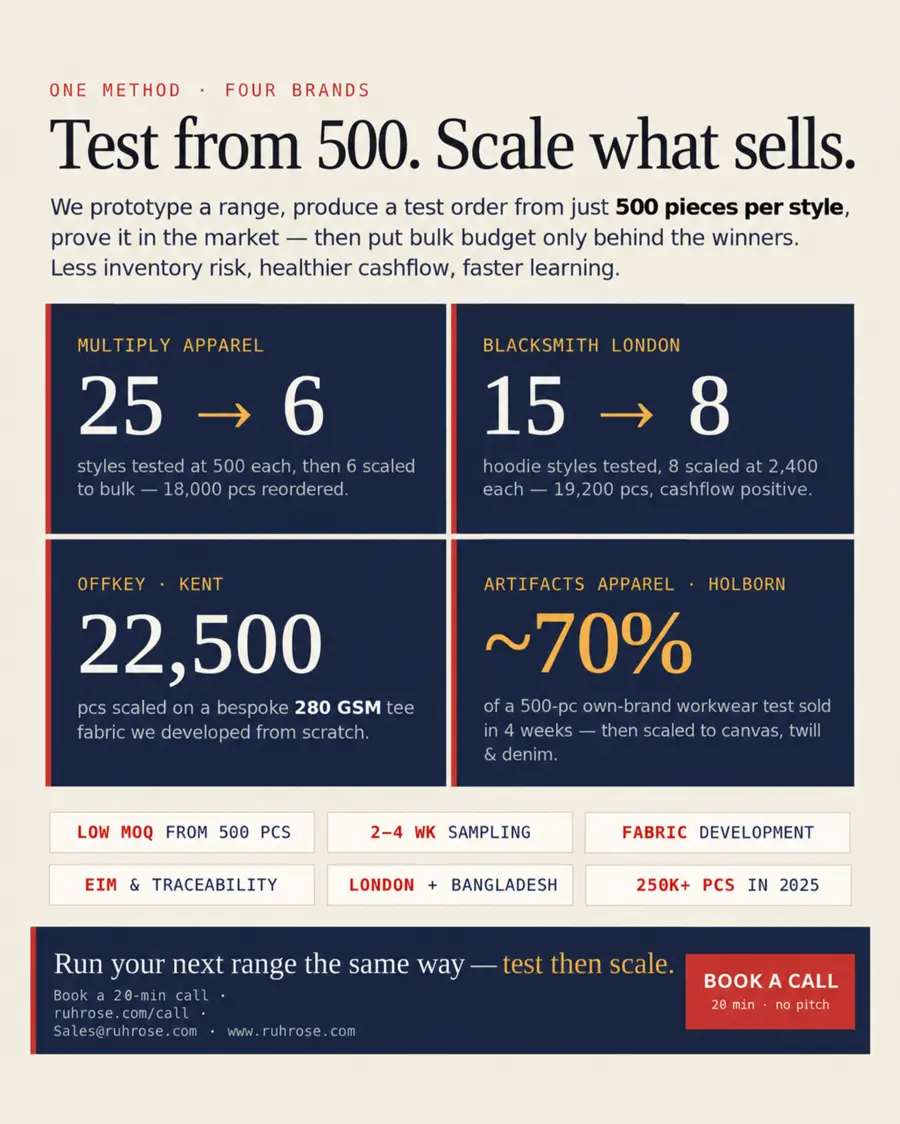
For a proven bestseller, you need scale. For an unproven product, you need flexibility — development support, clear communication, problem-solving, and a supplier willing to start around 500 pieces per style and colour, learn from the result, then move quickly when something works. Because that first small order is doing two jobs at once: testing the product, and testing the supplier.
Did the fit work? Did the wash match the approved sample? Did the supplier solve problems, and keep you informed while they did it? If both answers are yes, you check capacity, confirm lead times, and scale. If they aren't, you've learned before committing 5,000 or 10,000 pieces — which, for a brand building a genuinely sustainable range, can mean far less stock committed before real demand is understood.
Ruhrose's Test & Scale Approach
At Ruhrose, this thinking shapes how we work with buyers from the first enquiry. We're a UK-led, Bangladesh-manufactured apparel partner supplying hoodies, jersey, denim and woven casualwear, produced through BSCI, WRAP, OEKO-TEX and GOTS-audited facilities. Test first, learn, then scale — rather than committing to volume before you know whether the product and the partnership actually work.
More capacity doesn't always create more value. Sometimes it creates the wrong partnership. So the real question isn't how big a factory is — it's whether it's the right supplier for what you're trying to do. Big volume needs scale. Newness needs flexibility. Both still need quality, transparency and reliable delivery, which is what a smarter sourcing strategy is actually built on.