
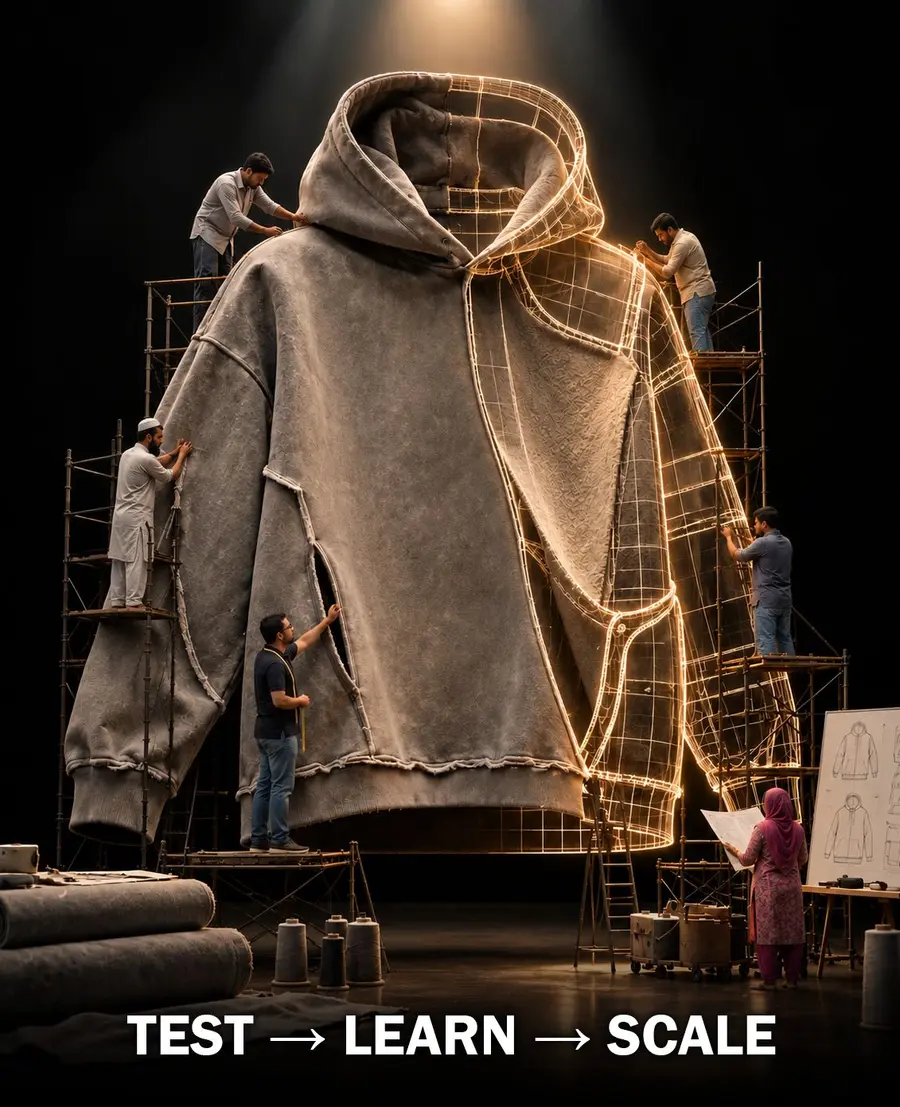
A Great Sample Isn't Proof of Demand
Last season's bestseller can guide you, but it doesn't prove demand for a new option. The strongest evidence is real customer behaviour, because every unproven garment sitting in stock ties up cash that could be working somewhere else. When you're searching for ethical clothing manufacturers UK, check more than the supplier's product range — ask where production happens, how working conditions are verified, and whether they can support smaller tests followed by reliable repeat orders. That combination is the foundation of a sensible jersey and T-shirt wholesale programme.
Three Questions Before Committing to a Bulk Jersey Order
1. Can we test it smaller?
Instead of predicting the winner, launch a controlled quantity first. For a new jersey range, that could mean starting around 500 pieces per style and colour — enough to gather genuine feedback without committing the full volume upfront.
2. What exactly are we testing?
Colour? Wash? Fit? Graphic? Price point? Don't change everything at once, or you won't know why one option performed better than another. Keep the test focused and the results will actually be usable.
3. How quickly can we scale the winner?
This is the part people often miss. A small MOQ alone isn't the solution. If your supplier can make 500 pieces but needs another 16 weeks to replenish, you could miss the selling window entirely. You need both a small initial commitment and reliable repeat capacity behind it.
What Replenishment Actually Depends On
When comparing suppliers found through an ethical clothing manufacturers UK search, ask how replenishment actually works in practice: fabric availability, production space, repeat wash consistency, and confirmed lead times. A promise to scale needs a practical plan behind it, not just a willingness to say yes.
What to Check in the Jersey Fabric and Finish
Before any test order is confirmed, the fabric itself deserves the same scrutiny as the design. GSM (grams per square metre) determines drape and weight — too light and a hoodie or T-shirt can feel cheap, too heavy and it can feel stiff. Fibre composition affects both feel and durability: 100% cotton jersey breathes differently from a cotton-elastane blend, and a recycled or organic cotton content should come with traceability documentation you can actually check, not just a claim on a swing tag. Ask your supplier to confirm shrinkage and colour-fastness testing on the specific fabric batch used for your bulk order, not just the original development sample — fabric can vary batch to batch, and a supplier who tracks this proactively is one worth building a longer relationship with.
Construction quality matters just as much for jersey as for more structured garments. Check seam finishing, rib consistency on cuffs and hems, and print or embroidery placement tolerance before bulk cutting begins. These are small details individually, but across a few thousand pieces they're the difference between a range that reorders well and one that generates returns.
Test Several Options, Let Customers Decide
Test several options, let customers show you what they want, then put your volume behind the winners. This won't suit every product — core lines with predictable demand may justify larger commitments from the start. But new washes, colours, fits and graphics deserve a different conversation. Why commit all the volume before receiving any market feedback at all?
Searching for ethical clothing manufacturers UK is only a starting point. Check the evidence behind ethical claims alongside product quality and delivery capability — a successful sales test doesn't replace those checks. The objective isn't simply to buy fewer garments. It's to make bigger commitments once you have better information, and that distinction can change your entire buying strategy.