
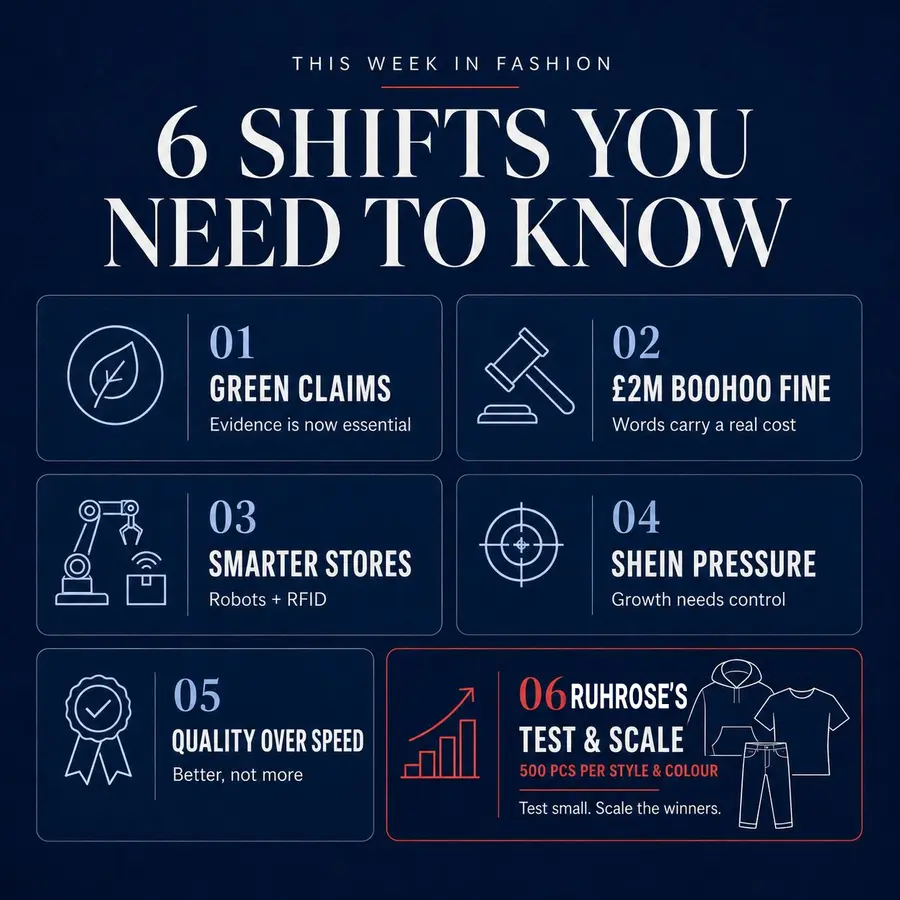
1. Green Claims Face Stricter Rules
New EU consumer protection rules apply from 27 September 2026, and generic environmental claims now face tighter restrictions. Words like "eco-friendly," "green" and "better for the planet" need more than good intentions behind them — the rules also strengthen information requirements around durability and consumer guarantees. For buyers, the lesson is practical: ask for evidence before approving any environmental claim on a product or a hangtag.
2. Why Product Language Matters
France's consumer watchdog fined Boohoo €2.3 million — approximately £2 million — over findings that included misleading discounts and describing synthetic products using terms such as "leather" and "suede." Product descriptions need the same care as product development. What you say about a garment must match what you're actually selling. At Ruhrose, we believe clearer product information starts with better sourcing conversations from the very first brief.
3. Bringing Technology Into Stores
Inditex-owned Lefties has opened its first UK store at Liverpool ONE, with robotic hanger sorting and RFID self-checkouts that mean customers don't need to scan every item separately. Retail is about more than the garment — convenience matters, and so does the technology behind the in-store experience.
4. Why Growth Needs Control
SHEIN's story has moved beyond preparing for a listing — it listed in Hong Kong on 1 September 2026, and its first results since listing showed a sharp fall in quarterly adjusted profit, with freight costs and import duties adding pressure. The lesson is straightforward: scale alone doesn't protect margins. Growth needs operational and financial discipline behind it. For sustainable fashion wholesale, that means looking beyond volume to stock exposure, total costs, and the underlying strength of the supply chain.
5. A More Considered Approach to Collections
Sézane is slowing its pace — creating more focused collections, giving design and materials more attention, and moving slightly upmarket. More products aren't always the answer. Sometimes, better-developed products are.
6. A Practical Starting Point: Test & Scale
Start around 500 pieces per style and colour, launch the product, study customer demand, identify the winners, then confirm repeat capacity and place larger orders. This can help limit the initial stock commitment and give buyers better information before scaling. Small orders alone don't prove sustainability — material traceability, manufacturing practices and evidence behind claims still matter — but testing demand can support far more disciplined buying overall.
What These Six Changes Have in Common
Looked at together, these six developments aren't separate stories — they're the same pressure showing up in different parts of the business. Regulators are tightening what can be claimed. Courts and watchdogs are enforcing what's said about a product. Retailers are investing in operational efficiency. And scale, on its own, is being shown not to protect margin when costs and compliance aren't managed alongside it. A buyer who treats these as connected — rather than six unrelated headlines — is better placed to adjust sourcing, product language and order volumes together, rather than reacting to each one separately as it comes up.
These six developments point towards a more considered fashion industry: clearer claims, smarter stores, controlled growth, better product decisions, and more learning before larger commitments. For buyers and sourcing managers, the practical question is which of these changes should influence your next buying decision.
Inspired by industry updates shared by Lydia Brearley, with reporting checked and updated.