Why the Old Sourcing Model Is Breaking
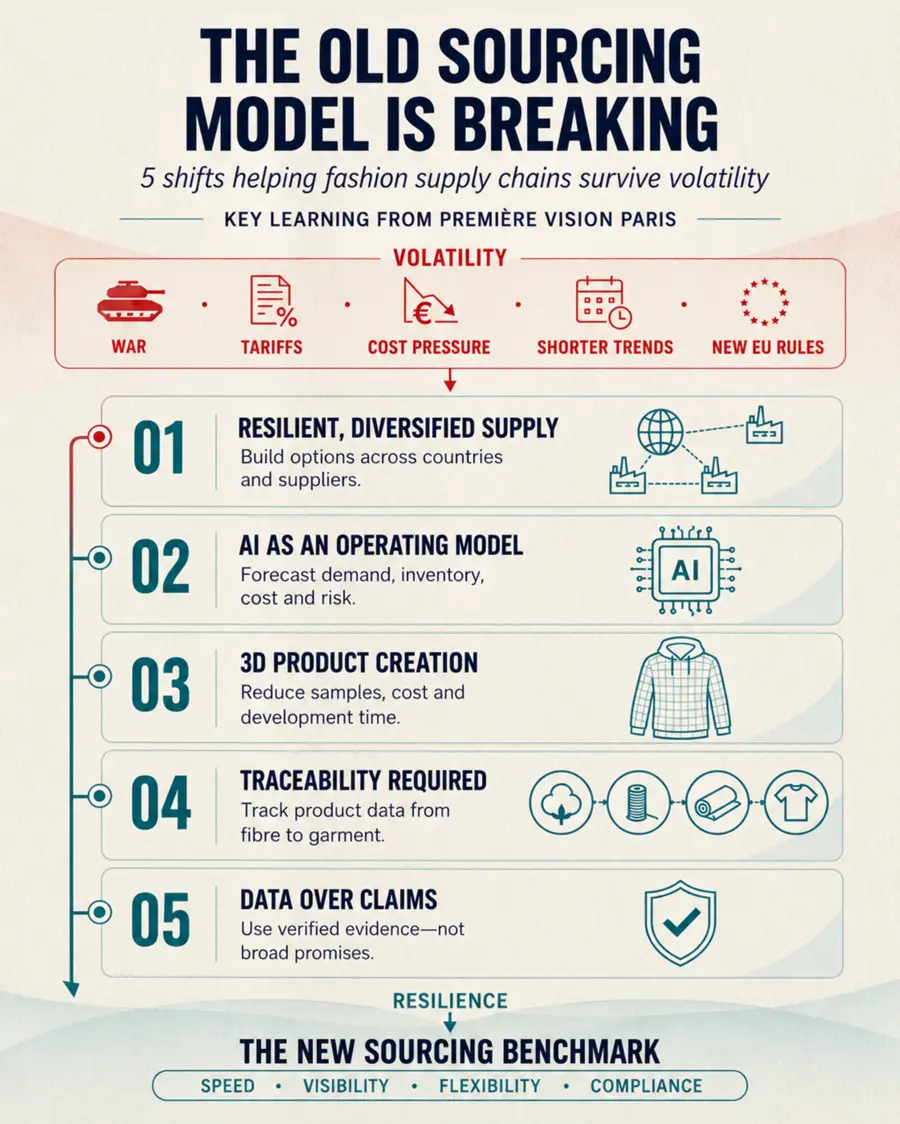
Trends move quickly, margins are under pressure, and buyers need more visibility into how products are made than a price-and-volume conversation can give them. For sustainable fashion wholesale specifically, the sourcing conversation needs to go beyond price and volume entirely. So what does the new sourcing model actually look like? Five pillars stood out to me from that session.
1. Resilient, diversified supply
Never depend completely on one country, supplier or shipping route. Build alternatives, and understand their capabilities before disruption happens rather than after. That thinking shapes our approach to production planning at Ruhrose.
2. AI as an operating model
Use AI to support forecasting, inventory planning, costing and early risk detection — but check the data, and question the output. Better tools still need good judgement behind them.
3. 3D product creation
Review designs digitally before making several physical samples. Reduce avoidable sampling rounds and make decisions earlier, then confirm fabric feel, washes and performance through physical testing once the concept is right.
4. Traceability
Know where the fibre, fabric and finished garment come from. Who made them? Where were they processed? What records support the information? For sustainable fashion wholesale, visibility needs to reach beyond the finished garment, through BSCI, WRAP, OEKO-TEX and GOTS-audited stages of production.
5. Data over claims
Saying a product is "sustainable" is no longer enough. Buyers need clear, verifiable evidence — material records, relevant certifications, measured process data, and clarity about what that evidence actually proves.
How These Pillars Change a Sourcing Conversation
In practice, this shifts what a first meeting with a supplier should cover. Instead of opening with price per unit and minimum order quantity alone, a buyer working to these five pillars will ask where the fabric comes from, what happens if a primary shipping route is disrupted, what evidence sits behind any sustainability claim, and how quickly a design can move from concept to physical sample. None of that replaces a competitive price — it sits alongside it, and it's usually the difference between a supplier relationship that survives a disruption and one that doesn't.
It also changes how a sourcing team is structured internally. Diversified supply means someone has to actually own supplier relationships in more than one region, not just the cheapest one. Traceability means procurement and compliance need to be talking to each other regularly, not just at audit time. None of the five pillars work well in isolation — they depend on each other, which is part of why treating sourcing as a single price negotiation tends to break down under real-world pressure.
What This Means for Sustainable Fashion Wholesale Buyers
The sourcing benchmark for sustainable fashion wholesale goes beyond the lowest price. It's about speed, visibility, flexibility, quality and compliance together. For buyers and sourcing managers, the practical question is simple: is your supply chain being redesigned for the world ahead, or still operating for the world that has already changed?