
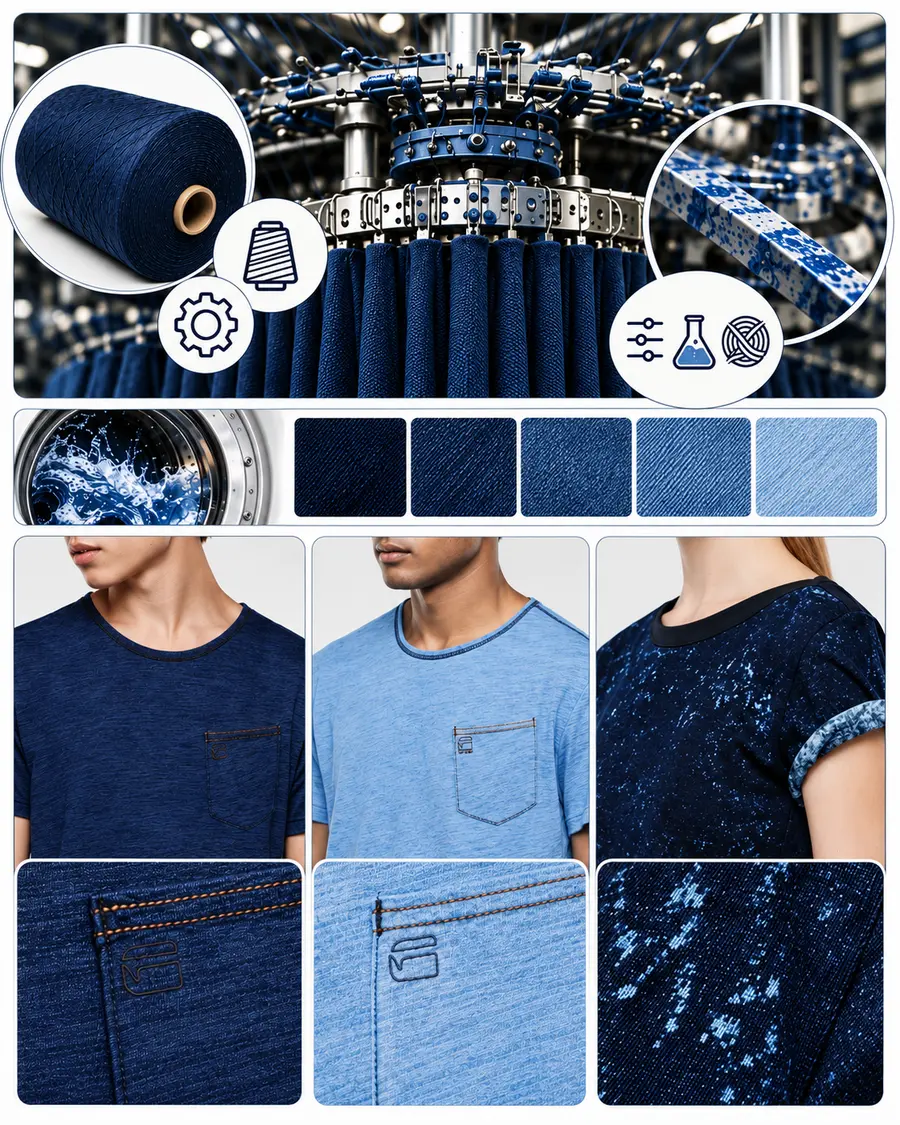
An Unusual Idea: Indigo Yarn, Knitted Into Jersey
We started with Epyllion in Bangladesh, working closely with their knitting, dyeing and finishing teams. Mr. Saeed, then GM of the fabric unit, was heavily involved from early on. The first challenge was the yarn itself: a yarn designed for weaving doesn't automatically run well through a knitting machine. Different tension, different movement, different demands on the fibre. So we worked with Envoy to develop an indigo yarn suitable for knitting specifically.
For buyers comparing sustainable denim suppliers, this is a useful reminder: understanding indigo means understanding more than just the final wash. The yarn and the construction matter just as much, and that development mindset has stayed with us at Ruhrose ever since.
When the Knitting Machine Turned Blue
Then came the moment I still remember clearly. We put the yarn on the knitting machine, and the machine started turning blue — indigo was rubbing off the yarn and depositing onto the machine as it ran. An exciting idea had suddenly become a real manufacturing problem.
Solving It With Epyllion's Knitting, Dyeing and Finishing Teams
I spent days and nights with Epyllion's knitting, dyeing and finishing managers. We experimented, adjusted yarn tension, worked on the yarn itself, changed machine settings, knitted again, washed, tested, failed, adjusted, and tried again. When assessing sustainable denim suppliers, ask how they actually handle difficult developments like this one: can they explain the problem clearly? Bring the right technical people together? Test solutions properly rather than guessing? A supplier's response to failure tells you something a sales presentation never can.
What a Denim-Character Jersey Fabric Opened Up
Eventually, we started getting what we wanted: a jersey fabric with the character of denim. And that opened another door — because the yarn was indigo dyed, we could experiment with techniques normally associated with jeans on T-shirts, sweatshirts and other jersey garments. Different washes, fades, bleaching effects, different shades of indigo. A technical problem had become a genuine new product playground, and the development eventually became part of a successful G-Star indigo jersey and sweats programme.
Innovation Alone Doesn't Prove Sustainability
But innovation alone doesn't prove sustainability. When comparing sustainable denim suppliers, technical creativity should sit alongside traceability and evidence about the processes actually used. Both deserve proper questions before you commit a programme to a new fabric idea.
What This Means for Buyers Developing Denim-Inspired Jersey Today
The same principle applies well beyond one factory in 2013. Any development that borrows a technique from one category and applies it to another — indigo dyeing moved from weaving to knitting, a wash process moved from denim to jersey, a finish developed for one fabric weight applied to another — carries the same risk of an unexpected failure mode. The lesson isn't to avoid ambitious development; it's to build in the testing time and the right technical partners before committing to a delivery date. A supplier who pads a development timeline to allow for genuine trial and error is usually more reliable than one who promises a fast turnaround on something neither side has actually made before.
The biggest lesson I took from that project wasn't the final garment — it was this: real product innovation rarely starts with knowing exactly how to make something. Sometimes it starts with an idea that doesn't work. Then a machine turns blue. And that's when the real product development actually begins.