
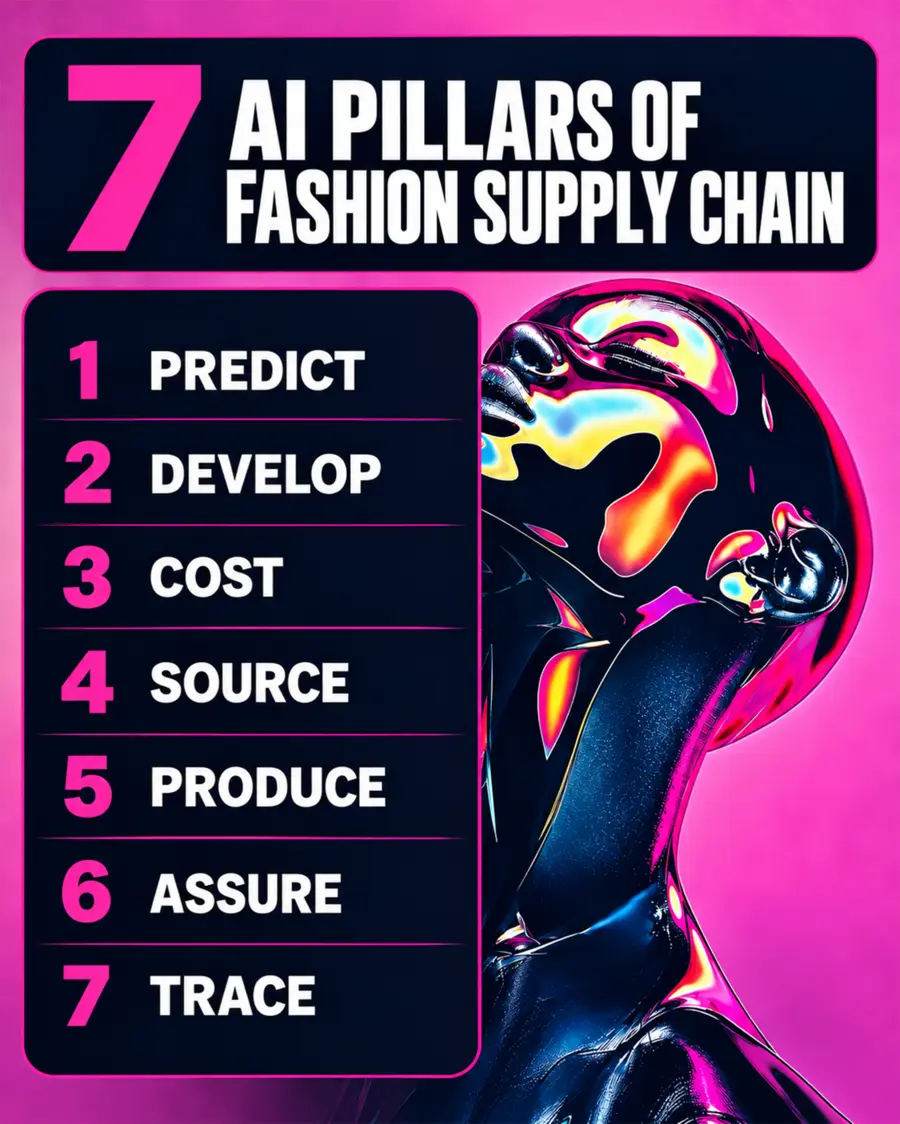
The 7 AI Pillars of Fashion Supply Chains
One message stood out to me across the sessions: AI is becoming part of more fashion conversations — design, marketing, sales — but how do we turn that interest into practical supply chain improvements? Better decisions need better information, and that's what this framework is built around.
1. Predict
Support demand forecasting, explore colours, quantities and repeat opportunities, and help buyers cross-check their own assumptions. Forecasts still need testing against real customer behaviour before volume is committed.
2. Develop
Explore product ideas, draft tech packs, and build clearer product briefs — giving experienced development teams more time to review and refine, rather than starting from a blank page.
3. Cost
Analyse garment costs, compare quotations, and flag unusual prices or missing items, then check the assumptions behind the numbers before a quote is accepted.
4. Source
Match products with suppliers using verified capability and performance records — fabric experience, wash expertise, MOQ, delivery history. Relationships still matter; evidence just makes those relationships easier to assess fairly.
5. Produce
Review order updates, flag potential delays, and highlight missing approvals, helping teams act before a small issue turns into a delivery problem.
6. Assure
Analyse inspection reports, identify recurring defects, and connect customer feedback with production problems, helping teams investigate the actual causes rather than just the symptoms.
7. Trace
Organise records from fibre to finished garment and flag missing documents, making product information easier to retrieve. AI can help manage traceability data — but it cannot create proof that was never collected in the first place, which for sustainable fashion wholesale is an essential distinction.
The Pillars Are Connected
These seven pillars aren't independent — poor information at one stage affects the next. A weak forecast can create excess stock. A poor supplier match can create quality problems. A missed warning can lead to late delivery. Missing records can weaken traceability. AI can help experienced people spot these patterns and investigate earlier, but the results depend entirely on the data feeding them, and on people actually acting on what they find.
What This Means for Buyers
For buyers, the potential benefits include faster decisions, better supplier matches, lower inventory exposure, fewer repeated quality problems, and clearer product records — and for sustainable fashion wholesale, these should be outcomes you actually measure, not just outcomes you assume. The key lesson from Texworld Paris was simple: start with the problem. Map your own seven pillars, find where delays, errors or missing information cost you most, then test one useful AI solution at a time, measure the result, keep what works, and improve what doesn't.
A Worked Example: Where the Pillars Meet in Practice
Take a single reorder decision as an example of how these pillars connect. A Predict tool flags that a jersey style is trending ahead of forecast. A Source record confirms which audited facility has spare capacity and prior experience with that fabric. A Cost check compares the reorder quote against the original approved price and flags a variance worth questioning. A Produce update tracks the order once it's placed, and an Assure record confirms the previous batch passed inspection with no recurring defects. None of these steps is complicated on its own — the value comes from having all seven connected, so a buyer isn't chasing five separate systems to make one reorder decision with confidence.